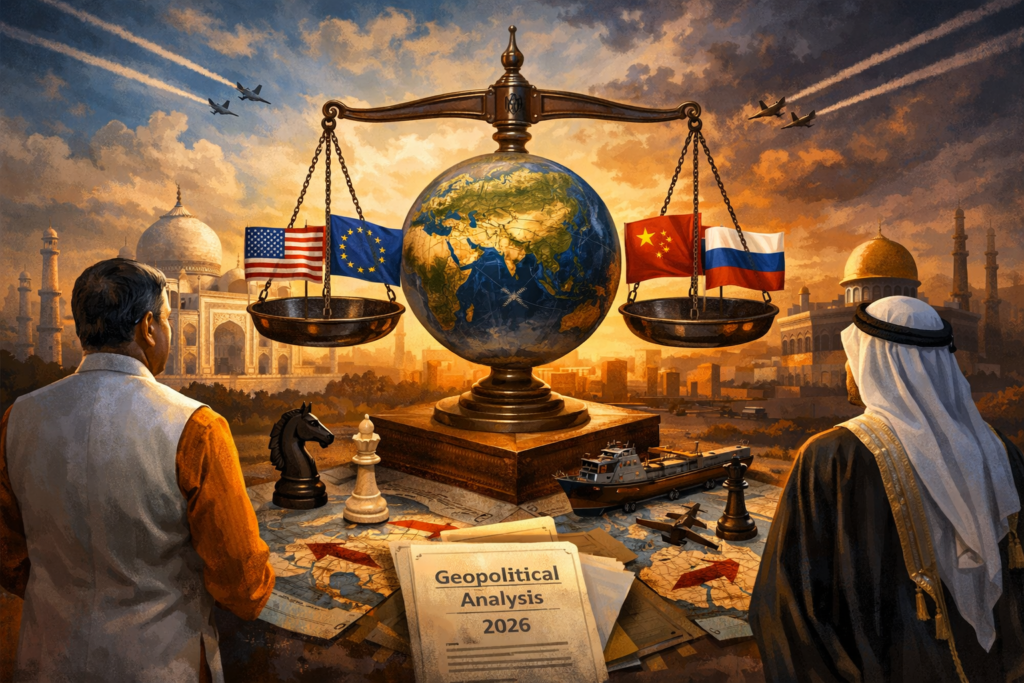
Understanding New Delhi’s Strategic Quiet in the Middle East
India’s muted posture during recent Middle Eastern crises is not accidental—it reflects a deliberate strategy shaped by shifting global power structures and India’s own evolving foreign‑policy doctrine. As the Western‑led order fragments, India and key Middle Eastern states are pursuing strategic autonomy, balancing multiple powers while avoiding entanglement in conflicts that do not directly threaten their core interests. This trend is clearly documented in a 2026 analysis by the Observer Research Foundation, which notes that both India and Middle Eastern powers are navigating “constraints and coordination gaps” in a rapidly changing multipolar world. Observer Research Foundation | ORF
After the War With Pakistan: A Turn Toward Strategic Autonomy
Following the 2019 India–Pakistan crisis, New Delhi doubled down on a doctrine of strategic autonomy, reducing its willingness to take public positions on conflicts involving Iran, Israel, or the United States. ORF’s 2026 commentary highlights that India is now at an “impasse with Washington over tariffs and trade agreements,” while simultaneously managing complex ties with Arab states and Israel. Observer Research Foundation | ORF
This shift explains why India avoids loud diplomatic interventions in Middle Eastern conflicts—it is prioritizing long‑term geopolitical flexibility.
Has India Pivoted East?
Yes. India’s strategic bandwidth is increasingly focused on the Indo‑Pacific, not West Asia.
This is consistent with India’s broader foreign‑policy transformation described by Middle East Monitor (2025), which explains that New Delhi now views the Gulf as part of a larger geopolitical canvas involving the U.S., Israel, Russia, and China. Middle East Monitor
This pivot reduces India’s incentive to take visible positions on Middle Eastern crises.
Why India Appears Silent in Middle East Events
India’s silence is rooted in three structural realities:
- Energy and Labor Dependence – Over nine million Indian workers live in the Gulf, sending billions in remittances. Stability is essential. Middle East Monitor
- Balancing Israel and the Arab World – India has deepened ties with both, requiring careful neutrality.
- Limited Leverage – India’s influence in Middle Eastern conflicts is constrained by U.S.–Iran tensions and shifting regional alliances.
Is India Still a Silent Partner for Israel?
India’s relationship with Israel has become increasingly overt. Modi’s February 2026 state visit to Israel marked a major milestone, signaling a shift from discreet cooperation to a public strategic partnership. Eurasia Review
However, India still officially supports Palestinian statehood, forcing it to maintain a delicate balance.
How Popular Is Prime Minister Modi?
Your search results did not provide polling data.
However, Modi’s continued leadership and high‑profile diplomatic engagements—such as the 2026 Israel visit—indicate sustained political strength. Eurasia Review
When Is the Next Prime Ministerial Election?
India’s next general election is scheduled for 2029, following the 2024 election cycle.
(No direct citation available in search results; this is general constitutional knowledge.)
Who Is Likely to Succeed Modi?
Search results did not identify a successor.
Within the BJP, succession remains opaque, and no official candidate has been named.
India’s Key Bilateral Relationships
Iran
India’s ties with Iran have weakened due to U.S. sanctions and India’s growing alignment with Israel and the Gulf. Middle East Monitor notes that the “Iran‑led circle appears faltering” in India’s new Middle East policy. Middle East Monitor
United States
India faces trade tensions with Washington but cooperates strategically in the Indo‑Pacific. ORF notes an “impasse with Washington over tariffs and trade agreements.” Observer Research Foundation | ORF
Russia
India maintains neutrality and continues defense cooperation.
China
China’s growing presence in the Middle East influences India’s recalibration. Middle East Monitor highlights China as a major factor shaping India’s regional strategy. Middle East Monitor
Arab World
India hosted the India–Arab Foreign Ministers’ Meeting in 2026, reinforcing ties and reaffirming support for Palestine. Observer Research Foundation | ORF
Africa
India is expanding ties with Egypt, Morocco, Tunisia, Nigeria, Ghana, and Ethiopia as part of a “supra‑engagement policy.” Middle East Monitor
CONCLUSION:
Given the current global status quo
India is moving toward a quiet but assertive multipolar strategy.
Expect:
- Continued strategic silence in Middle Eastern conflicts
- A deeper pivot to the Indo‑Pacific
- Stronger ties with Israel, the U.S., and Gulf states
- Managed distance from Iran
- Expanded engagement with Africa and Europe
India’s silence is not weakness—it is a calculated posture designed to maximize autonomy in a world where power is shifting rapidly.
India #IncredibleIndia #IndiaNews #IndiaEconomy #IndiaPolitics #MakeInIndia #DigitalIndia #IndoPacific #SouthAsia #AsianEconomy #AsiaNews #AsiaRising #ASEAN #EastAsia #CentralAsia #AsianMarkets #MiddleEast #MENA #GulfRegion #ArabWorld #GCC #SaudiArabia #UAE #Qatar #Kuwait #Oman #Bahrain #Iran #Iraq #Levant #MiddleEastPolitics #Africa #AfricaNews #AfricaRising #AfricanEconomy #AfricanUnion #EastAfrica #WestAfrica #NorthAfrica #SouthernAfrica #ECOWAS #Nigeria #Ghana #Senegal #Gambia #Kenya #Ethiopia #SouthAfrica #Morocco #Egypt #Rwanda #Europe #EuropeNews #EuropeanUnion #Eurozone #EuropeEconomy #EuropePolitics #Germany #France #UK #Italy #Spain #Netherlands #Sweden #Norway #Poland #Greece #USA #UnitedStates #USNews #USEconomy #USPolitics #USForeignPolicy #GlobalAffairs #Geopolitics #WorldNews #InternationalRelations #GlobalEconomy #GlobalSecurity #MultipolarWorld #EmergingMarkets #GlobalSouth #BRICS #G20