AfricanGlobalInsight.com — Published: 1 May 2026, 19:0
Glory to God and the powerless wise
Hopefully there are some left, and hopefully they will gain some decision making clout in this age of insanity.
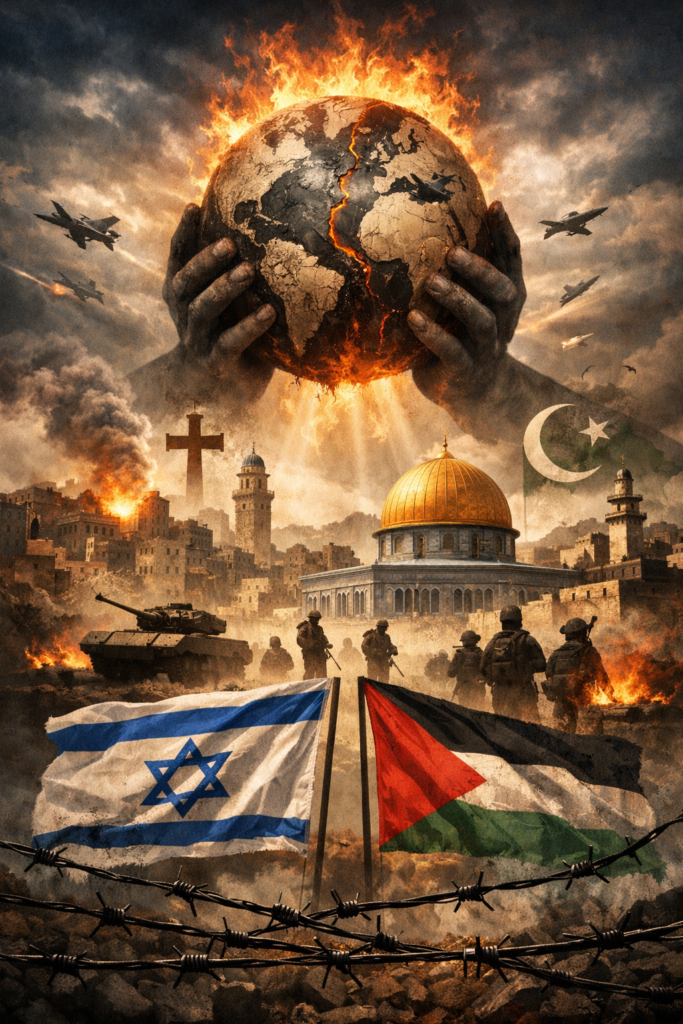
This article examines how racism, supremacist ideologies, and messianic narratives have historically fueled wars of conquest and subjugation, culminating in today’s Middle East conflicts. The study argues that the erosion of the two‑state solution, combined with religious zealotry and geopolitical rivalries, creates a perpetual‑war environment that threatens regional and global stability. Throughout history, wars have often been justified by ideologies of racial, religious, or civilizational superiority. Empires from Rome to Britain, and movements from European colonialism to 20th‑century fascism, framed domination as destiny. Scholars such as Fanon (1961) and Said (1978) have shown how racialized hierarchies rationalized conquest and subjugation.
In the modern Middle East, these patterns reappear through competing narratives of chosenness, divine entitlement, and civilizational mission—each claiming legitimacy over land and people.
II. Historical Patterns of Supremacy and Subjugation
2.1 Colonial and Imperial Precedents
European colonialism in Africa and the Middle East relied on racial hierarchies to justify dispossession (Mamdani, 1996). The Sykes‑Picot Agreement (1916) carved the region into artificial states, ignoring indigenous populations (Anderson, 2013).
2.2 Modern Nationalisms and Identity Conflicts
The 20th century saw the rise of:
- Arab nationalism
- Zionist nationalism
- Persian civilizational revivalism
- Islamist political movements
Each claimed historical or divine legitimacy, often at the expense of coexistence.
III. Messianic Narratives and the Politics of Divine Destiny
3.1 Theological Claims to Land
Some religious movements interpret ancient texts as literal land deeds. Academic studies (Bunzl, 2007; Lustick, 2019) document how certain factions within Israel view the West Bank as divinely promised, while some Islamist and Christian Zionist groups frame the conflict in apocalyptic terms.
3.2 The Clash of Civilizational Myths
The Middle East conflict is not merely territorial—it is civilizational. Competing narratives include:
- Jewish messianic nationalism
- Islamic eschatological resistance
- Christian Zionist prophecy frameworks
- Persian revolutionary ideology
These narratives reduce political compromise to religious betrayal.
IV. Israel, Iran, and the Architecture of Perpetual War
4.1 Israel’s Security Doctrine and Expansionist Currents
Israel’s wars are officially framed as defensive. However, scholars such as Pappe (2006) and Shlaim (2019) argue that expansionist currents exist within Israeli politics. Journalistic investigations (Haaretz, 2024; The Guardian, 2023) highlight tensions between security needs and settlement expansion.
4.2 Iran’s Regional Strategy
Iran positions itself as the primary counterweight to Israel, supporting armed groups in Lebanon, Syria, Iraq, and Gaza. Analysts (Nasr, 2006; Al Jazeera, 2024) describe this as a deterrence network designed to prevent direct confrontation.
4.3 The Proxy War System
The region’s conflicts increasingly operate through proxies:
- Hezbollah in Lebanon
- Militias in Iraq and Syria
- Hamas and Islamic Jihad in Gaza
- Israeli covert operations across the region
This creates a self‑sustaining cycle of retaliation.
V. The Collapse of the Two‑State Solution
5.1 Structural Barriers
The two‑state solution has been undermined by:
- Settlement expansion (UN OCHA, 2024)
- Political fragmentation among Palestinians
- Shifts in Israeli politics toward the far right
- U.S. policy inconsistencies (Foreign Affairs, 2023)
5.2 Consequences of a One‑State Reality
Without Palestinian sovereignty:
- Resistance becomes permanent
- Israel remains in perpetual conflict
- Lebanon, Syria, and Iraq remain destabilized
Security without justice is historically unsustainable.
VI. Physics as Metaphor: The Marble in the Bowl
Conflict behaves like a marble tossed into a bowl:
- It circles violently
- Collides with the edges
- But eventually settles in the center
Equilibrium requires:
- Mutual recognition
- Shared rights
- Sacrifice on both sides
Maximalist dreams—whether of Greater Israel or a region without Israel—guarantee endless war.
VII. The Military‑Industrial Complex and the Economics of Endless Conflict
Across the region and globally, powerful institutions profit from war:
- Arms manufacturers
- Intelligence contractors
- Proxy militias
- Foreign powers seeking influence
Eisenhower’s warning about the “military‑industrial complex” (1961) remains relevant. War becomes a business model; people become expendable.
VIII. The Human Dimension: The Existence of Sane, Wise Voices
Despite the dominance of zealots, millions across the U.S., Israel, Palestine, Iran, and the Arab world reject supremacist narratives. Journalistic accounts (New York Times, 2024) document Israeli and American activists who support Palestinian rights.
These voices rarely hold political power—but they represent the only sustainable path forward.
IX. Conclusion: Supremacy Leads to Ruin, Equality Leads to Peace
History shows that:
- Empires collapse
- Ideologies fade
- People remain
The Middle East’s future will not be shaped by those who dream of divine conquest. It will be shaped by those who understand that no people can be free while another is subjugated.
Equilibrium—not domination—is the only path to peace.
References (Hybrid Academic + Journalistic)
- Al Jazeera. (2024). Iran–Israel regional dynamics. Doha.
- Anderson, S. (2013). The Invention of the Middle East. University of Chicago Press.
- Bunzl, M. (2007). Anti‑Semitism and Islamophobia. University of California Press.
- Eisenhower, D. (1961). Farewell Address.
- Fanon, F. (1961). The Wretched of the Earth. Grove Press.
- Foreign Affairs. (2023). U.S. Policy in the Middle East.
- Haaretz. (2024). Israeli settlement expansion analysis. Tel Aviv.
- Khalidi, R. (2020). The Hundred Years’ War on Palestine. Metropolitan Books.
- Lustick, I. (2019). Paradigm Lost: From Two‑State Solution to One‑State Reality. University of Pennsylvania Press.
- Mamdani, M. (1996). Citizen and Subject. Princeton University Press.
- Nasr, V. (2006). The Shia Revival. W.W. Norton.
- New York Times. (2024). Israeli and American activists supporting Palestinian rights.
- Pappe, I. (2006). The Ethnic Cleansing of Palestine. Oneworld.
- Said, E. (1978). Orientalism. Pantheon.
- Shlaim, A. (2019). The Iron Wall. Penguin.
- UN OCHA. (2024). West Bank settlement data.
- The Guardian. (2023). Middle East conflict reporting. London.
#love #instagood #photooftheday #fashion #beautiful #happy #cute #tbt #followme #picoftheday #art #nature #travel #fitness #food #motivation #life #style #fun #smile #friends #family #music #photography #inspiration #selfie #summer #beauty #health #travelgram
#asia #fyp #foryou #foryoupage #viral #travel #asian #asiangirl #asianfood #asiantiktok #china #thailand #singapore #vietna
#arab #dubai #uae #oman #saudiarabia #algeria #beirut #arabic #middleeast #habibi #arabs #yemen #bagdad #arabstyle #emirates #gulf_cars #arabiC
#africa #african #africantravel #africanature #africanadventure #africanfood #africanmusic #africanfashion #africanheritage #africanwildlife #africanstartup #africatech #africaninnovation #africanpride #african
#europe #london #germany #france #italy #spain #travel #photography #photooftheday #sunset #vacation #wanderlust #travelgram #architecture #mountains #city #travelphotography #european
#usa #america #newyork #losangeles #california #texas #florida #travelusa #usatravel #american #usa🇺🇸 #nyc #hollywood #miami #chicago #washingtondc